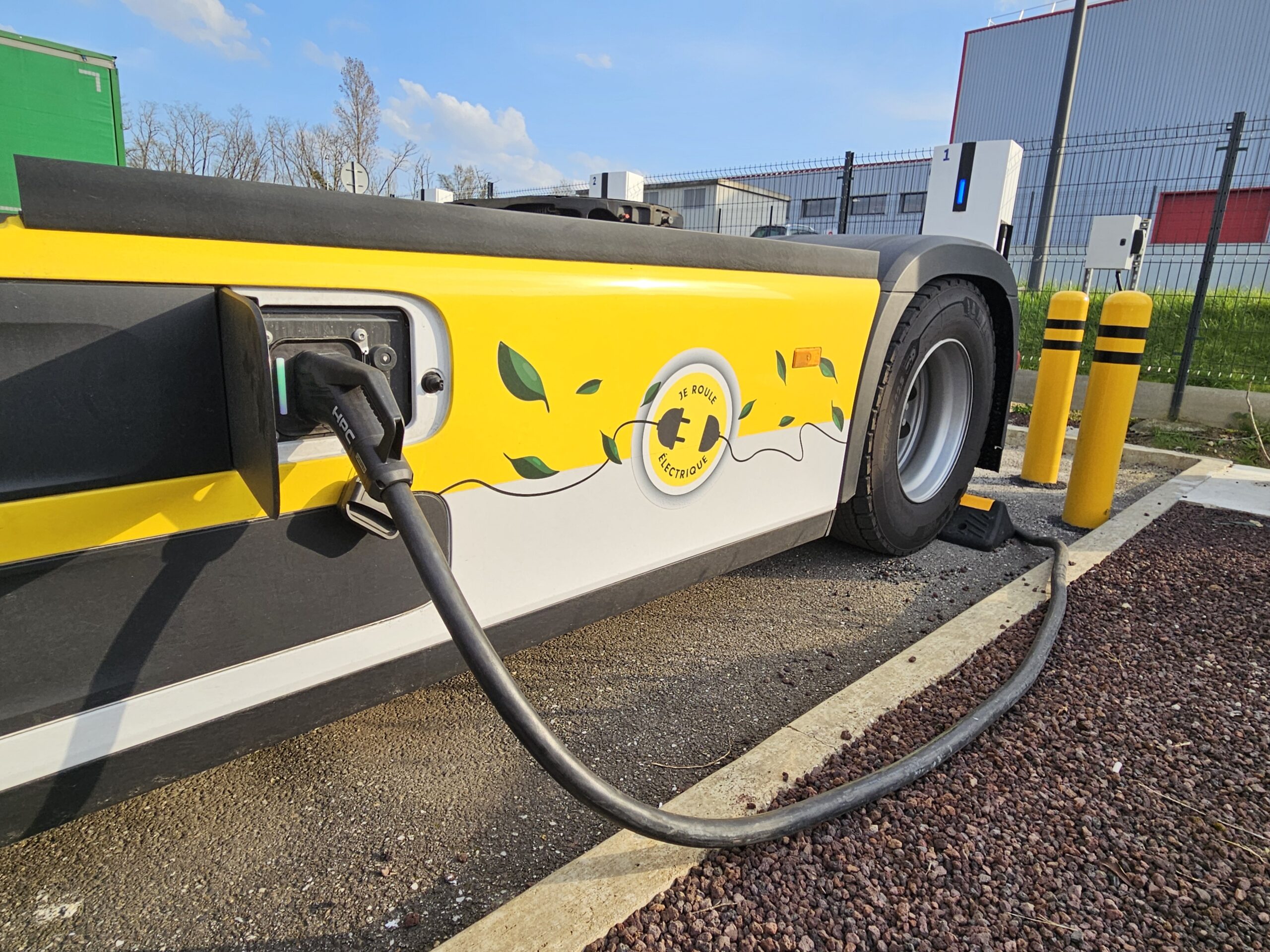
In 2026, the question is no longer whether heavy transport fleets should electrify.
The real question has become more direct: can they still remain competitive without doing so?
This year marks a quiet but defining shift: where electric stops being an alternative… to become a non-negotiable condition for market access.
1. Electric Trucks are finally fit for real-world operations
For a long time, the barrier was simple: “The technology isn’t ready.” That is no longer the case.
In 2026, major manufacturers like Volvo, MAN, Renault Trucks, DAF, Daimler and Scania offer electric ranges covering all requirements:
- From 3.5 t to 44 t
- Urban distribution, regional transport, and industrial logistics1
- Up to 500 km of daily operational range1
- And up to 800 km with planned intermediate charging
Crucially, these vehicles are no longer prototypes: several studies and operational feedback now show operational availability rates above 95% for certain urban and regional uses.
The challenge is no longer technical. It is organisational.
To explore: Our e-Trucks Data Hub to compare ranges based on your real-world operations.
2. TCO is tipping: but only for those who structure their transition
The true tipping point in 2026 is not the vehicle. It is the Total Cost of Ownership (TCO).
Why the equation is changing
- Commercial diesel continues to rise structurally in cost
- Electricity remains more stable and can be optimised at the depot
- Maintenance costs drop by 30% to 50% depending on operational cycles
- The residual value of combustion-engine vehicles is becoming increasingly uncertain due to restrictions on access to urban areas and changes in regulations.
The 2026 Economic levers
- Government Incentives/Grants: up to £81,000 per heavy vehicle for UK
- Accelerated Tax Deduction: up to 40%
In some cases, the initial premium is absorbed within just a few years.
The Key Point (often underestimated)
TCO is only favourable if the transition is anticipated and structured:
- Correct sizing of the depot charging station
- Optimisation of charging, especially concerning electricity prices
- Purchasing strategy aligned with operational cycles
3. The HGV Charging Network is scaling up
This is probably the most structural change in 2026.
What is in place
- AFIR Regulation: requires high-power charging stations every 60 km on major European routes
- First public charging points up to 350 kW+ suitable for HGVs
- Rapid development of electrified logistics hubs
- Private depot infrastructures up to 400 kW
The model is becoming hybrid: public + private + semi-public.
What really changes for operators
- Progressive disappearance of uncertainty on long-haul journeys
- Ability to plan routes just like diesel operations
- Energy optimisation directly at the depot
The question is no longer ‘where to charge?’ but ‘how to optimise charging?’
4. Client pressure has become decisive
This is the most underestimated point.
Major clients are now integrating Scope 3 transport emissions into their selection criteria.
Concretely:
- Carbon emissions are becoming a market award criterion
- Certain tenders already exclude fleets with excessive emissions
- Electrification is becoming a direct competitive advantage
Failing to electrify is no longer just a technical choice. It is a commercial risk.
2026: A tipping point, not a sudden disruption
What characterises 2026 is not a sudden revolution. It is a convergence of factors that are now irreversible:
- Operational vehicles available at scale
- A favourable TCO
- A structured charging network
- Decisive client pressure
Electric is gradually becoming the standard for heavy fleets.
What fleets need to do now
The most advanced companies do not ‘switch’ all at once. They structure their transition in 4 steps:
- Identify immediately electrifiable uses
- Simulate the real TCO based on their operational cycles1
- Secure orders (long lead times)
- Size the charging infrastructure
Moving from analysis to decision
At Chargepoly, we support fleets in this transition with a global approach:1
- Audit of uses and fleet
- Personalised TCO simulation
- Design and deployment of fast-charging infrastructures
- Support for financing (Government Incentives, on-demand service)
In summary
2026 is not the year of the ‘all-electric.’ It is the year where fleets that anticipate gain a sustainable structural advantage.
And where, progressively, failing to electrify will no longer be neutral but penalizing.