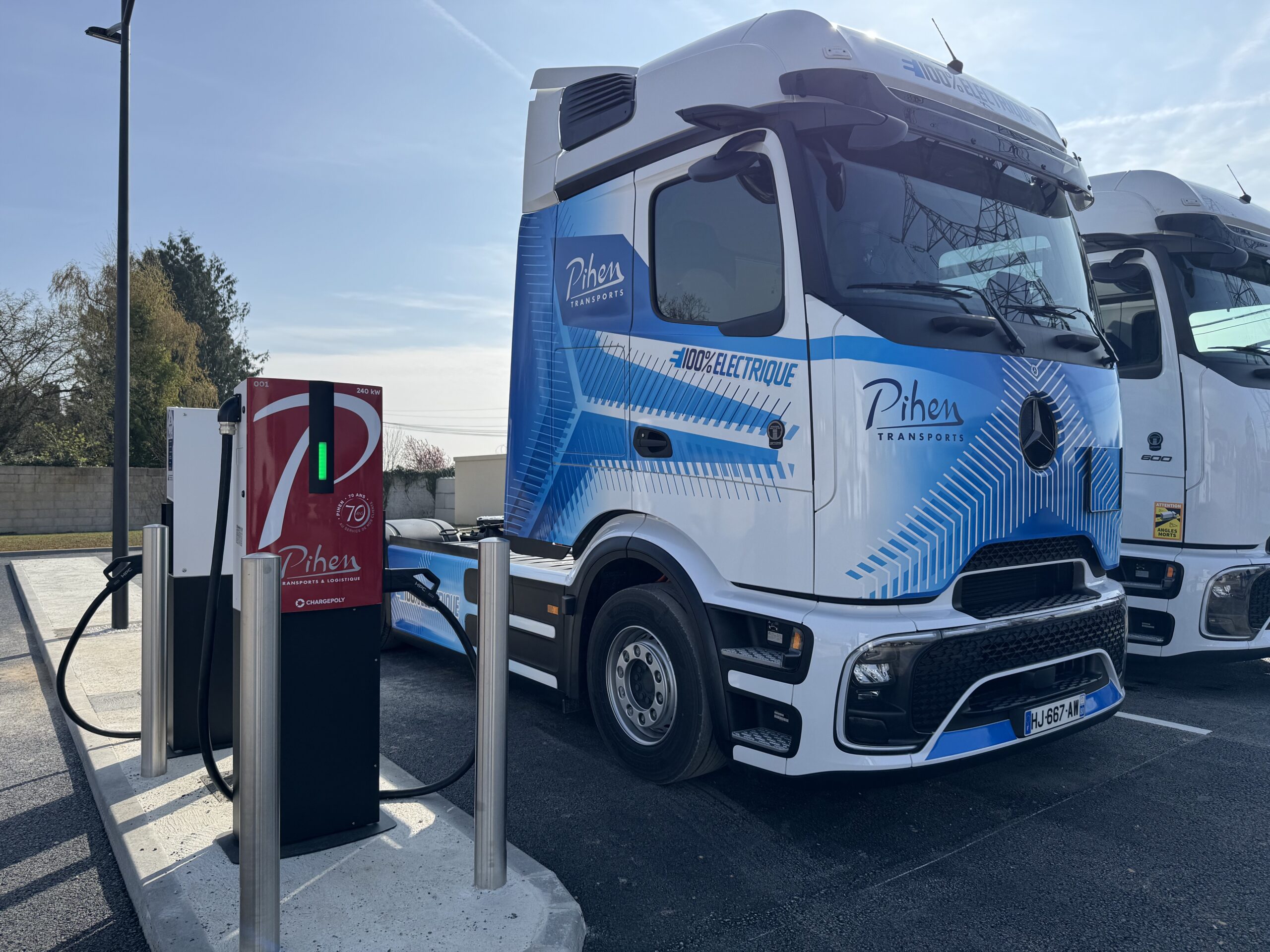
In a previous article, we covered a key challenge for electric fleets: charging station availability. But in real-world operations, availability is only part of the equation.
A charger can be available… without guaranteeing a successful charge.
This is where a still overlooked KPI becomes essential: the charging success rate.
Availability does not guarantee successful charging
In fleet operations, a charging point being available does not necessarily mean the charging session will complete.
A session can be interrupted or fail for several reasons:
- unstable communication between the truck and the charger
- grid limitations or power fluctuations
- vehicle-specific behaviours or compatibility issues
- on-site operational constraints (simultaneous usage, load management, etc.)
In these cases, the infrastructure is technically operational, but the vehicle is not charged.
For fleet operators, the impact is immediate: delayed routes, disrupted logistics, and direct financial consequences such as lost revenue or contractual penalties.
A rapidly evolving ecosystem in Canada
In Canada, and particularly in Quebec where electrification of heavy-duty transport is accelerating, the ecosystem is still maturing.
Technical standards are evolving, vehicle adoption is increasing, and interactions between vehicles, software, and charging infrastructure remain complex.
In this context, expecting every charging session to run perfectly is unrealistic.
The real operational question becomes: how do you ensure continuity when something goes wrong?
Turning charging interruptions into successful outcomes
At Chargepoly, a charging failure is never treated as a definitive stop.
The objective is to maximise the real-world charging success rate, even when technical issues occur.
This relies on several built-in system mechanisms.
Intelligent retry: automatically restarting charging sessions
When a session fails or is interrupted, the system can automatically restart it.
This retry mechanism helps to:
- reduce the need for manual intervention
- minimise vehicle downtime
- significantly improve full-charge success rates
For operators, this means fewer disruptions and smoother day-to-day operations.
Degraded mode: ensuring charging even under non-ideal conditions
In real-world fleet environments, optimal conditions are not always available.
Instead of stopping the session, charging stations can switch to a degraded mode.
This allows the system to:
- dynamically adjust charging power
- bypass temporary technical constraints
- still ensure the vehicle reaches a usable state of charge
The objective is not peak performance at all costs, but operational reliability: the truck must be ready to go.
Software intelligence as the backbone of reliability
These capabilities are powered by Lucie, Chargepoly’s embedded software and charging supervision system.
This software layer enables:
- real-time monitoring of charging sessions
- anomaly detection during operation
- dynamic adjustment of charging strategies
- continuous optimisation of system performance
This transforms charging infrastructure from a static system into an adaptive operational tool.
A more meaningful KPI than charger power ratings
In the industry, attention is often focused on charger power levels (150 kW, 350 kW, 400 kW and beyond).
But in daily fleet operations, this is not the most relevant metric.
For fleet managers, the real question is: how many vehicles are actually ready to operate every day?
This is exactly what the charging success rate reflects.
A shift toward operations-first charging infrastructure
In Canada’s heavy-duty transport sector, charging is not just a technology topic.
It is an operational challenge that requires:
- managing real-world failures
- anticipating vehicle behaviour
- continuously adapting charging systems
Key takeaway: reliability is defined in imperfect conditions
Charging infrastructure should not be evaluated only in ideal conditions.
Its real performance is measured in the field, where constraints are constant and variability is the norm.
Ultimately, one KPI matters most for fleet operators: vehicles charged, ready, and on the road.